GOOGLE.ORG IMPACT CHALLENGE: AI FOR SCIENCE
Accelerating scientific breakthroughs with the power of AI
AI is a critical lever to unlock scientific breakthroughs and understand the fundamental mechanisms of human health and climate systems. Building on the success of the inaugural AI for Science fund, Google.org is launching a supercharged initiative at the intersection of artificial intelligence and scientific discovery. By empowering researchers with catalytic funding and technical expertise, we aim to accelerate our understanding of key scientific questions—achieving Nobel-level breakthroughs and enabling science at digital speed.
The Google.org Impact Challenge: AI for Science is a $30M global open-call designed to empower researchers and organizations with the funding, tools, and technical expertise they need to accelerate scientific breakthroughs. Beyond funding, organizations may participate in a Google.org Accelerator and receive six months of dedicated pro bono technical support from Google experts and access to Google Cloud credits to help bring these projects to life.
How it works
-
Application & selection
Nonprofits, social enterprises, and academic institutions submit their application for funding towards scientific projects that will help accelerate their social impact. Applications will be reviewed by Google.org, Google subject matter experts, and external third-party specialists from our partner organizations, including Renaissance Philanthropy and the Centre for Public Impact.
Additional selection criteria are detailed below. Applications close May 1, 2026. -
Funding & support
Selected organizations will receive funding from Google.org (between $500K and $3M USD) and have the option to participate in a Google.org Accelerator, which supports organizations as they work to solve some of the world's most pressing scientific challenges by leveraging generative AI and agentic capabilities. This multi-month program accelerates high-impact solutions through dedicated pro bono technical support from Google experts.
Criteria
Before applying, ensure your project can demonstrate the following:
-
Scientific ambition & impact
Projects must pursue high-impact research in the following areas: AI for Health & Life Sciences, AI for Climate Resilience & Environmental Science. Proposals should be evidence-based and define clear, quantifiable success metrics.
-
Innovative & responsible use of AI
AI should be a core component of the solution, developed in alignment with Google’s Responsible AI Principles and shared via open-source licensing to benefit the public, or the solution should specifically enable future AI use cases (e.g. a foundational open dataset).
-
Feasibility
Applicants must provide a realistic execution plan, timeline, and budget. Teams must possess the necessary technical and domain expertise to successfully execute the proposed research.
-
Scalability & sustainability
Projects should demonstrate potential for scaled impact and/or relevance beyond their immediate scope. Applicants are encouraged to articulate how their outputs will be discovered, adopted, and maintained across scientific domains and geographies.
Focus areas
We’re particularly interested in proposals leveraging AI to help accelerate scientific breakthroughs in the fields of Health & Life Sciences and Climate Resilience & Environmental Science. However, we remain open to exceptional proposals in other fields that offer significant impact with strong alignment across criteria.
& Life Sciences
& Environmental Science
Accelerate scientific breakthroughs in the field of health and life sciences by supporting projects that decode the fundamental mechanisms of life and produce foundational models, agents, open datasets, and a predictive understanding of biology to revolutionize human health.
Previously funded recipients
-
Spore.Bio
This project builds a foundational microbiological emulator that integrates biophotonics with deep learning to automate the detection of antimicrobial resistance, helping to significantly boost diagnostic speed from days to minutes, ultimately freeing up valuable clinical time, reducing the spread of drug-resistant infections, and streamlining patient care.
-
Technical University of Munich
By integrating multi-scale biological data and an LLM interface, this initiative creates a "Google Maps" for human tissue that provides physicians with a holistic, spatially grounded view of cellular processes to enhance mechanistic diagnosis and intervention planning.
-
University of Washington
The University of Washington uses Fiber-seq and machine learning to create high-resolution maps of the human genome, helping to significantly boost the prediction of how genetic variations impact health, ultimately freeing up valuable research time, reducing genomic data complexity, and streamlining the path to personalized medical treatments.


Accelerate scientific breakthroughs that improve climate resilience, supporting projects that answer critical, unresolved questions about our planet’s living systems and/or enable novel approaches to better preserve those systems.
Previously funded recipients
-
Innovative Genomics Institute
This initiative develops an AI foundation model trained on cultivated rumen microbiomes to predict collective bacterial behavior and identify precise genetic interventions for mitigating enteric methane emissions.
-
The Sainsbury Laboratory
This project leverages AI-guided pipelines and AlphaFold to predict disease resistance genes from plant and pathogen genomes, accelerating the breeding of resistant crops by identifying functionally relevant matching protein structures.
-
University of Liverpool
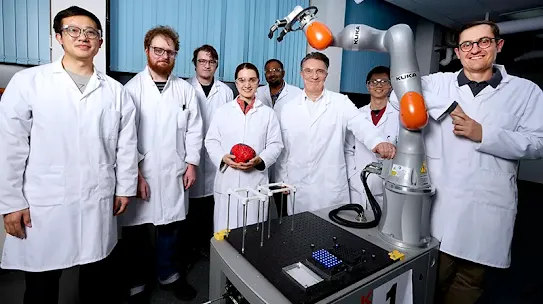
By implementing the "Hive Mind" methodology—a hybrid intelligence platform combining autonomous robotics, AI agents, and human expertise—this research discovers scalable, atomically engineered porous materials to capture atmospheric CO2 and establish a new paradigm for solving global energy and health challenges.
AI in science
Explore how Google is developing cutting-edge AI models to push the boundaries of scientific discovery and address global challenges.